

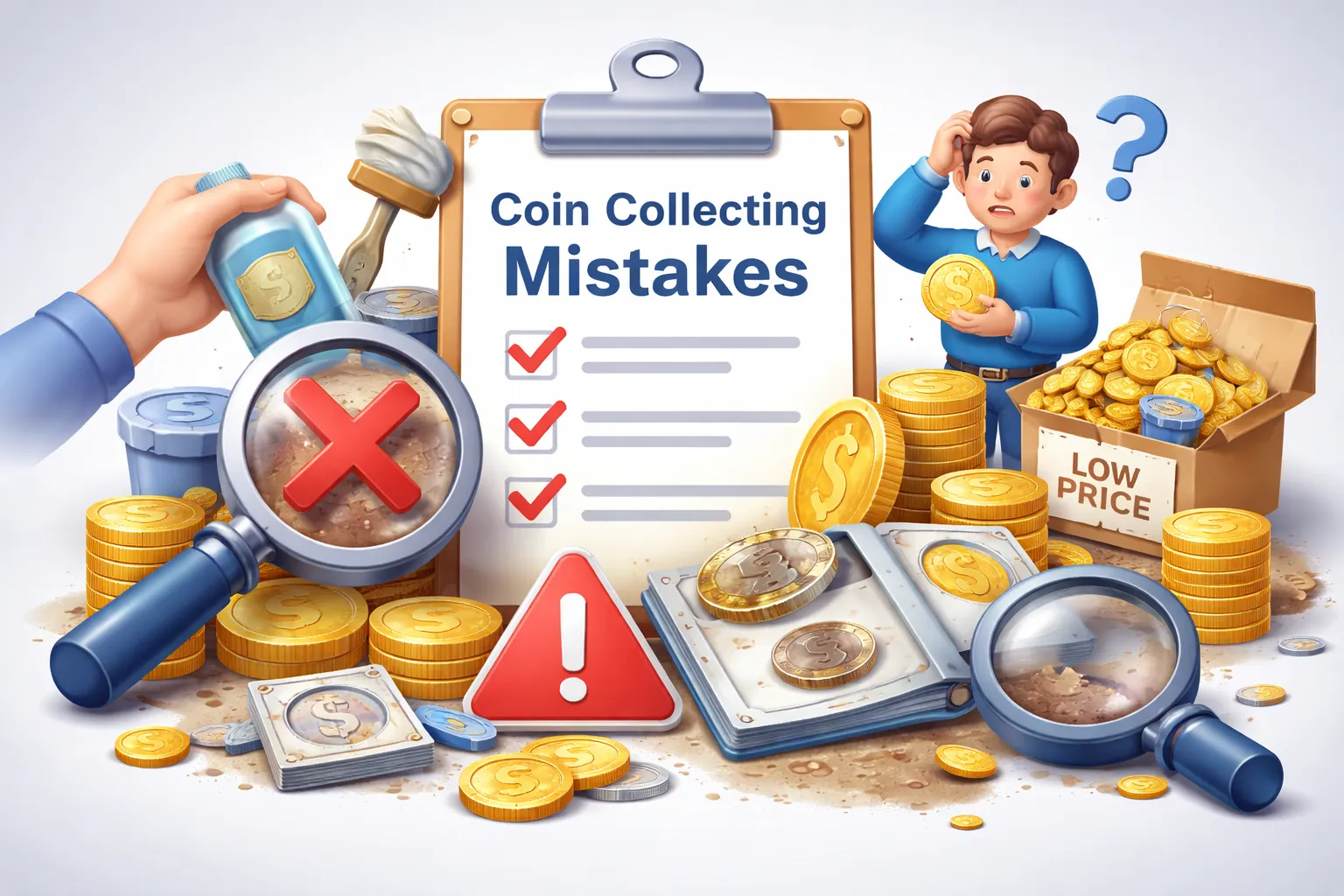
A systematic breakdown of where collectors lose value—and how to prevent it
Introduction
Most losses in coin collecting are not caused by bad luck. They are caused by predictable mistakes.
The market rewards precision, patience, and correct identification. It penalizes assumptions, speed, and lack of verification.
This guide isolates the most expensive mistakes—and shows how to eliminate them.
1. Cleaning Coins (Value Destruction)
This is the most common and most damaging mistake.
Many beginners assume that a “clean” coin is more valuable. The opposite is true.
Cleaning:
- Removes original surface (patina)
- Creates micro-scratches
- Signals tampering to collectors
Result:
A coin can lose 50–90% of its value instantly.
Rule:
Never clean a coin. Even if it looks dirty.
2. Ignoring Small Details (Mint Marks, Variants)
High-value differences often come from small, easily overlooked details.
Examples:
- Tiny mint marks (e.g., “D”, “S”, “P”)
- Slight design variations between years
- Error details only visible under magnification
Impact:
You may hold a rare variant and treat it as a common coin.
Correction:
Always inspect coins closely—or scan them.
Using WhatCoin, these micro-differences are identified instantly without manual research.
3. Assuming “Old = Valuable”
Age alone does not create value.
A widely produced coin from 100 years ago can be nearly worthless, while a modern low-mintage coin can be highly valuable.
Drivers of value:
- Scarcity
- Demand
- Condition
- Historical relevance
Mistake pattern:
Collectors hold low-value coins for years expecting appreciation that never comes.
4. Selling Without Proper Identification
This is where most financial loss occurs.
Selling a coin without full identification leads to:
- Undervaluation
- Selling to informed buyers who exploit the gap
- Missing rare attributes
Strategic error:
Acting before verifying.
Correction:
- Identify the coin
- Understand its rarity
- Compare market prices
WhatCoin compresses this process into seconds, eliminating guesswork.
5. Ignoring Condition (Grading)
Condition is a multiplier on value.
Two identical coins can differ in price by 10x or more based on condition alone.
Common mistakes:
- Not recognizing wear
- Overestimating condition
- Mishandling coins (causing damage over time)
Correction:
- Store coins properly
- Avoid direct contact
- Evaluate condition objectively
Use tools that help assess grading visually rather than relying on assumption.
6. Buying Without Knowledge
Impulse buying leads to poor capital allocation.
Typical behavior:
- Buying coins based on appearance
- Overpaying for common items
- Following hype without data
Outcome:
Capital gets locked in low-value assets.
Correction:
- Verify rarity before buying
- Compare real market prices
- Focus on asymmetric opportunities (low cost, high upside)
7. Poor Storage and Handling
Physical damage reduces value over time.
Risks include:
- Humidity
- Scratches
- Oxidation
- Direct handling with bare hands
Correction:
- Use protective holders
- Store in controlled environments
- Minimize handling
This is basic discipline—but often ignored.
8. Not Using Technology (Slow, Inefficient Identification)
Manual research is:
- Time-consuming
- Error-prone
- Inconsistent
This leads to missed opportunities and incorrect decisions.
The Efficient Alternative: WhatCoin
Instead of relying on fragmented sources:
- Scan any coin instantly
- Get identification and key details
- Understand rarity and estimated value
- Compare against real-world data
Result:
Faster decisions, fewer errors, higher capture of value.
9. Lack of a System
Most collectors operate randomly.
No tracking. No structure. No data.
Consequence:
They cannot distinguish between valuable assets and dead weight.
Correction:
- Build a digital collection
- Track valuations over time
- Identify top-performing coins
- Regularly reassess your portfolio
WhatCoin can function as the central system layer for this.
Conclusion
The gap between an average collector and a high-performing one is not knowledge—it is discipline and systems.
Most losses are avoidable:
- Do not alter the asset (no cleaning)
- Do not act without identification
- Do not rely on assumptions
Leverage tools like WhatCoin to:
- Increase identification accuracy
- Reduce decision time
- Capture value others overlook
Positioning takeaway:
In coin collecting, mistakes are expensive—but predictable.
If you eliminate them systematically, you gain a structural advantage over most of the market.